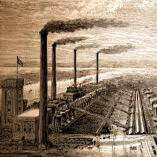
The Effects of the Industrial Revolution
Standards
SS.9-12.US.13 - Investigate the causes and effects of diverse ideologies on politics, society, and culture.
SS.9-12.US.14 - Evaluate the impact of individuals and reform movements on the struggle for greater civil rights and liberties.
SS.9-12.US.15 - Evaluate the factors that shape group and national identity and how the American identity has evolved.
SS.9-12.US.16 - Interpret events from a variety of historical and cultural perspectives, including but not limited to: suffragettes, civil rights activists, nationalists, progressives, political activists, immigrant groups.
SS.9-12.US.39 - Create, interpret, and utilize maps that display and explain the geo-spatial patterns of cultural, economic, political, and environmental characteristics.
SS.9-12.US.40 - Analyze how and why the U.S. landscape changed as people adapted the environment to meet their needs.
SS.9-12.US.42 - Explain how global circumstances and interaction affect resources, land use, culture, and population distribution in the U.S.
SS.9-12.US.2 - Generate and answer supporting questions while explaining how they contribute to an inquiry and how new compelling and supporting questions emerge through the inquiry process.
SS.9-12.US.38 - Evaluate the social, political, and economic changes that influence the interpretation of the Constitution and evolution of law.
SS.9-12.US.35 - Explain how American identity is shaped by founding documents, political participation, democratic institutions, and the interactions among diverse cultures.
SS.9-12.US.36 - Explain the historical background of a current national issue and propose a course of action to solve it.
SS.9-12.US.4 - Evaluate the credibility of a primary and secondary source.
Lesson 1
The industrial revolution made a huge impact on many countries. It's primary cause is the creation and usage of free-market capitalism, where citizens handle their own economy rather than the government, which has lead to poor working conditions and child labor, which leads to several socialist ideologies and movements (Marxism, Utopia Socialism, etc). Robert Owen, a socialist, said that it's possible for wealthy people to make a profit while also giving their workers better pay, which ends up improving pay wages for years to come.Unions/movements are also prominent during this time. Since child labor and poor pay wages were still implemented, unions were formed in order to put a stop to it and improve the lives of workers. There have also feminist movements, fighting for the equal treatment of both men and women alike. In the past, women were often used for jobs such as textile manufacturing, and are given half the payment compared to men.The Industrial Revolution has also played a part in urbanization, which is converting rural areas to urban areas. Due to the creation of factories and the rise of immigration to find work, there have been more urban areas and less rural areas was well as an increase in population, at the expense of landowners being forced out of their homes and finding jobs in said urban areas.The United States has gone through many events during this time, one of which being the switch from agriculture to mass manufacturing, leading to more workers and higher economic power, leading to the increase of the working class. By the early 1830s, they were in the lead in terms of economy. These events caused unions and movements, and due to them, permanently changed how the united states functions today.
Lesson 2
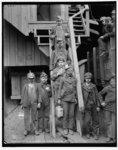
Due to free-market capitalism, child labor was a prominent aspect of the industrial revolution. It wouldn't take long for people to take notice and protest against it, leading to a law reducing the work time per week by a few hours. However, mill owners found a workaround by increasing workload to make up for the loss in time. Evidence of this is found in pictures.There has also been cases of child workers being treated like "ragdolls," with one case where police prevented a group of children from boarding a train and attacked them, with one being given a black eye and thrown to a wagon.Punishment for such cases are usually towards parents for lying about their child(s)' age, but rarely towards the mill as children are working illegally. This would lead to a movement towards child labor legislation over the years, of which mill owners and manufacturers are against on.Bills were passed in an attempt to raise the minimum age requirement to 14, but after much little success, the Fair Labor Standards Act of 1938 would be successfully passed after World War II.
Lesson 3
Upon the United States becoming a capitalist country, it has shown improvements during the second Industrial Revolution. Wealthy people became wealthier, a richer middle class, and a better working class due to immigration, with a rapidly growing city. Technology has also been evolving, going from walking to automobiles. Since technology is improving, mass production has also increased as well, causing all sorts of goods being created easier, at the expense of hard factory work by low wage workers.
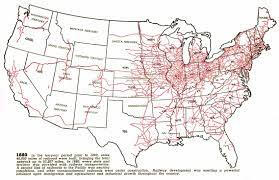
In the image below, the red lines on the map represent the railroards being expanded during the industrial revolution. They are spread across the states.
Lesson 4
The United Kingdom is one of the first countries to start their industrial revolution. Aware of their advantage, they banned exportation of anything that could give any other country a head start as well, up until they found profit from it. Other countries, such as France, would start their industrial revolutions as well, and while they would be successful, Great Britain would continue to be the leading powerhouse. Nonetheless, all countries would improve their technologies and use mass production.There are various social effects of the industrial revolution, some of which include labor unions/reforms, a better standard of living, and more job opportunities. Due to these aspects, pay wages have improved and as such workers are treated more fairly. Immigration has also allowed the constitution to be influenced due to more people voicing their ideas on how it can be better.Prior to the Industrial Revolution, the United States had a more rural livestyle, where there was more skilled labor than unskilled labor. However, unskilled labor would become popularized thanks to manufacturing.
Lesson 5
Prior to the Industrial Revolution, the United States had a more rural livestyle, where there was more skilled labor than unskilled labor. However, unskilled labor would become popularized thanks to manufacturing.The 4th industrial revolution is more or less the same as the previous ones: technology develops and becomes more advanced, but in today's times. Some examples include in being artificial intelligence, DNA alterations, and augumented reality. It's important to have an idea of the three previous industrial revolutions because they have led up to the 4th one, and for that people can create something new based on what they know about the previous revolutions.
Quick Note
Primary sources are the most reliable type of sources as they are created around the same time as the event(s) that took place. Primary sources include autobiographies, recordings, pictures, etc. When identifying if a source is a primary source or a secondary source, take note of the date that the source was taken.
join our quizizz
quizizz.com/join
sources:
https://www.historycrunch.com/impacts-of-the-industrial-revolution.html#/
https://www.historycrunch.com/impacts-of-the-industrial-revolution.html#/
https://www.khanacademy.org/humanities/whp-origins/era-6-the-long-nineteenth-century-1750-ce-to-1914-ce/64-transformation-of-labor-betaa/a/read-responses-to-industrialization
https://education.nationalgeographic.org/resource/industrialization-labor-and-life
https://www.learner.org/series/a-biography-of-america/the-rise-of-capitalism/
https://www.bls.gov/opub/mlr/2017/article/history-of-child-labor-in-the-united-states-part-2-the-reform-movement.htm
https://www.history.com/topics/industrial-revolution/child-labor
https://libguides.bellevue.edu/c.php?g=937568&p=6757312
https://www.alvinisd.net/cms/lib/TX01001897/Centricity/Domain/7118/
https://www.loc.gov/classroom-materials/united-states-history-primary-source-timeline/rise-of-industrial-america-1876-1900/overview/
https://www.britannica.com/event/Industrial-Revolution/The-first-Industrial-Revolution
https://www.lcps.org/cms/lib4/VA01000195/Centricity/Domain/10599/Social%20Effects%20of%20the%20Industrial%20Revolution.pdf
https://education.nationalgeographic.org/resource/industrialization-labor-and-life
https://education.seattlepi.com/extent-did-industrial-revolution-change-american-social-economic-political-life-6960.html
https://www.weforum.org/agenda/2016/01/the-fourth-industrial-revolution-what-it-means-and-how-to-respond/
https://www.loc.gov/classroom-materials/industrial-revolution-in-the-united-states/
https://blogs.bu.edu/guidedhistory/moderneurope/andrew-readel/